
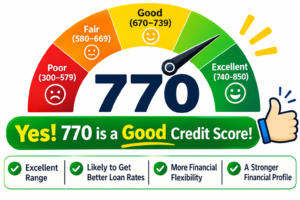
A 770 credit score is considered very good under the standard FICO scoring model and good under commonly used VantageScore models. It indicates that you have a strong credit profile and a history that generally suggests responsible credit management. With this score, you may qualify for a wide range of financial products, including rewards credit cards, auto loans, personal loans, and mortgages.
A score of 770 puts you in a favorable position compared with many borrowers. Lenders generally view applicants with higher credit scores as lower-risk borrowers, which can improve their chances of receiving competitive interest rates and loan terms. However, your credit score is not the only factor lenders consider. Your income, existing debt, payment history, employment, and the specific scoring model used can also influence approval decisions.
Although 770 is already a strong score, there is still room to move toward 800 or higher. Understanding how your score works and which financial habits protect it can help you maintain your credit standing and make better borrowing decisions.
Is 770 a Good Credit Score?
Yes, a 770 credit score is very good under FICO’s standard scoring system. FICO scores range from 300 to 850, and the very good category includes scores from 740 to 799. A score of 770 falls comfortably within this range.
VantageScore uses different category boundaries. Under commonly used VantageScore models, a score between 661 and 780 is considered good, while 781 to 850 is excellent. This means a 770 score is classified as good under VantageScore, even though it is very good under FICO.
A 770 score generally suggests that you have managed credit responsibly. It can help you qualify for financial products with more competitive terms than those typically offered to borrowers with lower scores.
What a 770 score means for you:
- You have a strong credit profile compared with many borrowers.
- You may qualify for competitive credit card and loan offers.
- You may have better chances of receiving favorable interest rates.
- You may qualify for rewards cards with attractive benefits.
- You are close to the exceptional FICO category, which begins at 800.
- Maintaining your payment history and low credit utilization can help protect your score.
A 770 score is an excellent position from which to manage your financial goals. The key is to maintain responsible habits rather than taking unnecessary risks to gain a few additional points.
Understanding Credit Score Ranges
Credit scoring companies use different categories to explain what a particular score means. Although FICO and VantageScore both commonly use a 300 to 850 range, their classifications are not identical.
Here is a general breakdown of FICO credit score ranges:
| FICO Score Range | Credit Category |
| 300–579 | Poor |
| 580–669 | Fair |
| 670–739 | Good |
| 740–799 | Very Good |
| 800–850 | Exceptional |
A 770 FICO score falls in the very good category. It is 30 points below the exceptional range.
VantageScore 3.0 and 4.0 use these general categories:
| VantageScore Range | Credit Category |
| 300–600 | Poor |
| 601–660 | Fair |
| 661–780 | Good |
| 781–850 | Excellent |
Under VantageScore, 770 is near the upper end of the good category.
Why the scoring model matters: You may see different scores from your bank, credit card company, or credit monitoring service. One provider may display a FICO score, while another may use VantageScore. Lenders can also use different versions of these models depending on the type of credit you are requesting.
For this reason, always identify which scoring model produced your number before comparing it with a credit score category.
Is a 770 Credit Score Good for Getting a Credit Card?
Yes, a 770 credit score can put you in a strong position when applying for a credit card. Many card issuers consider applicants with very good FICO scores attractive candidates, although approval is never guaranteed.
With a score of 770, you may have access to several types of credit cards, depending on your income, existing debt, credit history, and the issuer’s requirements.
Cash-back credit cards: These cards offer rewards on eligible purchases such as groceries, gas, dining, and everyday spending. A strong credit profile may help you qualify for cards with competitive reward structures.
Travel rewards cards: Some travel cards provide points or miles for purchases, along with benefits such as travel credits, airport lounge access, and other perks. Premium products may have annual fees and additional eligibility requirements.
Balance transfer cards: These cards may offer promotional interest rates on transferred balances. They can be useful for managing existing credit card debt, but transfer fees and promotional deadlines should be considered.
Premium rewards cards: A 770 score may put certain premium cards within reach. However, issuers may also consider income, existing credit limits, recent applications, and account history.
Before applying, compare annual fees, interest rates, reward conditions, and other costs. A card with attractive benefits is not necessarily a good choice if its fees exceed the value you receive.
Is a 770 Credit Score Good for Buying a Car?
Yes, a 770 credit score is generally a strong position for applying for an auto loan. Borrowers with higher credit scores often qualify for more competitive financing offers than applicants with lower scores.
However, the exact interest rate depends on several factors, including the lender, loan term, vehicle age, down payment, income, and current market conditions.
Competitive auto loan rates: A 770 FICO score may place you in a favorable credit tier with many lenders. You may have access to better rates than someone with fair or poor credit, although the best available rate is not guaranteed.
New and used vehicle financing: A strong score may help with financing either a new or used vehicle. Lenders can apply different requirements depending on the vehicle’s age, mileage, and value.
Down payment: Even with a 770 score, providing a down payment can reduce the amount you need to finance and lower your monthly payments.
Loan comparison: Compare offers from banks, credit unions, and dealership financing departments. Look at the annual percentage rate, total interest, repayment period, and fees rather than focusing only on the monthly payment.
If you are shopping for an auto loan, eligible applications submitted within a relatively short period may be grouped for scoring purposes by certain FICO models. The applicable rate-shopping window depends on the scoring version.
Can You Buy a House With a 770 Credit Score?
Yes, a 770 credit score can put you in a strong position when applying for a mortgage. It is above the commonly cited minimum credit score requirements for many conventional and government-backed mortgage programs.
A higher credit score may help you qualify for competitive mortgage pricing. However, lenders also evaluate your income, debt-to-income ratio, down payment, employment history, savings, and the property you want to purchase.
Conventional mortgages: A 770 score is generally above the minimum credit requirements for many conventional mortgage programs. Your eligibility and interest rate will still depend on the lender’s rules and the rest of your application.
FHA loans: FHA-insured mortgages are designed to provide financing options to eligible borrowers with different credit profiles. A 770 score is above the commonly cited FHA credit thresholds, but the loan’s overall cost and eligibility conditions should be compared with conventional financing.
Mortgage interest rates: Your score may help you qualify for favorable pricing, but the lowest advertised rate is not guaranteed. Mortgage rates also depend on loan size, loan term, down payment, property type, and market conditions.
Debt-to-income ratio: Lenders calculate how much of your gross monthly income goes toward debt payments. A manageable ratio can strengthen your application even when your credit score is already high.
Before choosing a mortgage, request quotes from multiple lenders. Compare the annual percentage rate, closing costs, mortgage insurance, and total borrowing costs.
What Factors Affect a 770 Credit Score?
Your credit score is calculated using information in your credit reports. Traditional FICO scoring models consider five major categories.
- Payment history
Payment history accounts for approximately 35% of a traditional FICO score. It reflects whether you make payments on credit cards, loans, and other reported accounts on time.
A strong payment history is one of the most important reasons a borrower may have a 770 score. Late payments, missed payments, and serious delinquencies can damage an otherwise healthy credit profile.
To protect your score, pay every account by its due date. Automatic payments and calendar reminders can help you avoid accidental late payments.
- Credit utilization
Credit utilization measures how much of your available revolving credit you are using. It falls within the amounts-owed category, which represents approximately 30% of a traditional FICO score.
For example, if your combined credit card limits are $20,000 and your total balances are $4,000, your utilization is 20%.
Lower utilization is generally better for your credit score. Keeping balances manageable can help protect a strong credit profile.
- Length of credit history
The length of your credit history accounts for approximately 15% of a traditional FICO score. It considers how long your accounts have been open and the age of your oldest and newest accounts.
A longer history of responsible credit management can support a strong score. Avoid closing older accounts without considering the potential effects on your available credit and credit profile.
- New credit
New credit accounts for approximately 10% of a traditional FICO score. It considers recent credit applications and newly opened accounts.
Several hard inquiries within a short period may temporarily lower your score. Avoid applying for unnecessary credit products simply because you receive promotional offers.
- Credit mix
Credit mix accounts for approximately 10% of a traditional FICO score. It considers the different types of credit accounts you manage, including revolving credit cards and installment loans.
A varied credit history can contribute positively to your score, but you do not need to borrow money just to create a different account type. Responsible management of existing credit is more important.
These percentages are general FICO guidelines. The exact effect of each category depends on your individual credit report and scoring model.
How to Maintain a 770 Credit Score
Reaching a 770 score is a positive achievement, but maintaining it requires consistent financial habits. Even a strong credit profile can decline if you miss payments, accumulate high balances, or apply for unnecessary accounts.
Pay every bill on time: Continue making payments by their due dates. Payment history is a major scoring factor, and protecting it should remain your priority.
Keep credit utilization low: Avoid using most of your available credit. Paying your credit card balances regularly can help maintain a healthy utilization ratio.
Avoid unnecessary applications: Apply for new credit only when you have a genuine financial need. Multiple applications can create hard inquiries and may temporarily affect your score.
Keep older accounts in good standing: Older accounts can contribute to your credit history. If an account has no annual fee and remains useful, keeping it open may help preserve available credit.
Monitor your credit reports: Check your reports from Equifax, Experian, and TransUnion for inaccurate balances, unfamiliar accounts, incorrect payment records, or duplicate collection entries.
Dispute genuine errors: If you discover incorrect information, you can dispute it with the relevant credit bureau and the company that supplied it. Disputing inaccurate information is free. Accurate negative information generally cannot be removed simply because you want a higher score.
Manage debt carefully: A high score does not mean you should take on additional debt. Keep borrowing within your budget and maintain an emergency savings fund where possible.
How to Improve a 770 Credit Score to 800
Moving from 770 to 800 may seem like a small numerical change, but it takes consistent credit management. Under FICO, 800 is the beginning of the exceptional category.
The following habits may help you strengthen your credit profile further.
Maintain a perfect payment record: Continue paying all reported accounts on time. A long history of reliable payments can support a strong score.
Reduce revolving balances: If your credit cards carry balances, consider paying them down. Lower utilization may help your score, especially if balances are currently high.
Avoid closing useful older accounts: Closing an older card can reduce your available revolving credit and affect utilization. Consider the account’s fees and benefits before closing it.
Limit new credit applications: You may not need additional accounts if your existing credit profile is already strong. Avoid applications that do not serve a clear financial purpose.
Check all three credit reports: Errors can affect even borrowers with high credit scores. Review your reports periodically and dispute inaccurate information.
Be patient with credit history: The length of your credit history cannot be increased overnight. Maintaining older accounts responsibly can help preserve this part of your profile.
Not every borrower with a 770 score needs to reach 800. A strong 770 score may already qualify you for competitive financial offers. Focus on the overall cost of borrowing rather than chasing a perfect number.
Is a 770 Credit Score Above the National Average?
Yes. According to FICO’s Fall 2026 Credit Insights report, the average U.S. FICO score was 714 in July 2026. A 770 score is 56 points higher than that reported average.
This comparison shows that a 770 FICO score is stronger than the national average. It falls within the very good category and generally signals responsible credit management.
However, the national average is not an approval requirement. Lenders use their own standards and evaluate other financial details when deciding whether to approve an application.
Your score should be considered alongside your income, debt, payment history, savings, and financial goals.
770 Credit Score vs. 750, 780, and 800
A 770 score is already very good, but understanding the difference between nearby score ranges can help you plan your next steps.
| Credit Score | FICO Category | General Meaning |
| 750 | Very Good | Strong credit profile |
| 770 | Very Good | Favorable borrowing position |
| 780 | Very Good | Toward the upper end of very good |
| 800 | Exceptional | Enters the exceptional category |
The difference between 770 and 800 is 30 points. Reaching 800 moves you into the exceptional FICO range, but it does not guarantee a lower interest rate on every financial product.
Some lenders offer similar pricing to borrowers across a broader score range. Others use specific score thresholds. Your income, debt, loan type, and other application details can still influence the final offer.
Common Mistakes to Avoid With a 770 Credit Score
Even with a strong credit score, certain financial mistakes can create problems. Avoiding them can help you protect your credit history.
Missing payment deadlines: A late payment can damage your payment history. Use reminders or automatic payments to stay organized.
Using too much available credit: High balances may increase utilization and reduce your score. Keep revolving balances manageable.
Applying for too many credit cards: Multiple hard inquiries may temporarily lower your score. Apply only when you need a new financial product.
Closing accounts without considering the impact: Closing an older card can affect your available credit and utilization. Review the account’s fees and benefits first.
Ignoring credit report errors: Incorrect information can affect your credit profile. Check your reports regularly and dispute genuine inaccuracies.
Borrowing more than you can afford: A high score does not mean you should accept every loan offer. Consider the total repayment cost before taking on new debt.
Conclusion
A 770 credit score is very good under the FICO scoring model and good under commonly used VantageScore models. It can put you in a favorable position when applying for credit cards, auto loans, personal loans, and mortgages. You may qualify for competitive interest rates and attractive financial products, although approval and pricing depend on your complete financial profile.
The best way to protect a 770 score is to maintain on-time payments, keep credit utilization low, avoid unnecessary credit applications, and review your credit reports for errors. Moving toward 800 may place you in the exceptional FICO category, but a 770 score is already a strong financial foundation. Focus on responsible borrowing and maintaining healthy financial habits rather than chasing points unnecessarily.
Frequently Asked Questions
- Is 770 a good credit score?
Yes, a 770 credit score is considered very good under FICO and good under commonly used VantageScore models. It may help you qualify for competitive credit cards and loans, depending on the lender’s requirements.
- Can I get a mortgage with a 770 credit score?
Yes, a 770 score is generally strong enough to meet the credit requirements for many mortgage programs. Approval also depends on your income, debt-to-income ratio, down payment, employment history, and the lender’s conditions.
- Can I get the best interest rates with a 770 credit score?
A 770 score may qualify you for competitive interest rates, but the lowest available rate is not guaranteed. Lenders also consider loan type, income, debt, down payment, and current market conditions.
- Is 770 better than the average U.S. credit score?
Yes. FICO reported an average U.S. credit score of 714 in July 2026. A 770 FICO score is above that average and falls within the very good category.
- How can I increase my 770 credit score to 800?
Continue paying bills on time, maintain low credit utilization, avoid unnecessary hard inquiries, keep useful older accounts in good standing, and review your credit reports for errors. Consistent credit management may help you move toward 800 over time.
Read More: 730 Credit Score: Is It Good, and What Can You Get With It?