
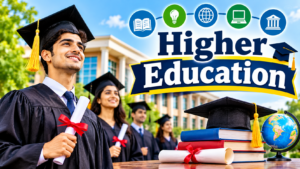
Higher education includes undergraduate degrees, postgraduate programs, doctoral studies, professional qualifications, and other advanced learning opportunities offered by colleges, universities, and recognised institutions. It helps students develop critical thinking, research abilities, communication skills, and practical knowledge in their chosen fields.
In today’s competitive world, higher education can open doors to different career paths and professional opportunities. It also encourages innovation, independent thinking, and lifelong learning. However, choosing the right course and institution requires careful planning, as students need to consider their interests, financial resources, academic background, and long-term goals.
This guide explores higher education, its importance, different types of qualifications, benefits, challenges, career opportunities, and the future of advanced learning.
What Is Higher Education?
Higher education refers to formal learning that takes place after secondary or high school education. It is generally provided by universities, colleges, institutes, and other recognised educational institutions.
Unlike school education, which usually introduces students to a broad range of subjects, higher education allows learners to specialise in particular academic or professional areas.
Students can choose programs in science, commerce, arts, engineering, medicine, business, law, technology, education, and many other fields.
Higher education combines classroom instruction, practical training, research activities, examinations, projects, internships, and other learning experiences. The structure depends on the institution, qualification, and academic discipline.
Undergraduate Education
Undergraduate education is usually the first level of higher education. It includes bachelor’s degree programs that provide foundational knowledge in a selected subject.
Examples include Bachelor of Arts (BA), Bachelor of Science (BSc), Bachelor of Commerce (BCom), Bachelor of Technology (BTech), and Bachelor of Business Administration (BBA).
Postgraduate Education
Postgraduate education is pursued after completing an undergraduate qualification. It allows students to develop advanced knowledge and specialise in a particular area.
Common examples include Master of Arts (MA), Master of Science (MSc), Master of Commerce (MCom), Master of Business Administration (MBA), and Master of Technology (MTech).
Doctoral Education
Doctoral education is an advanced level of academic study that generally focuses on original research and specialised knowledge.
A Doctor of Philosophy (PhD) is a common doctoral qualification. Students usually investigate a specific research question and contribute new knowledge to their academic field.
Professional Education
Professional education prepares students for specific careers that may require specialised qualifications or professional recognition.
Examples include programs in medicine, law, teaching, architecture, nursing, and other regulated or specialised professions.
Why Is Higher Education Important?
Higher education can influence an individual’s career opportunities, personal development, and ability to contribute to society. It provides structured learning experiences that help students understand complex subjects and prepare for professional responsibilities.
Developing Specialised Knowledge
Higher education allows students to study subjects in greater depth. They can learn advanced concepts, explore specialised topics, and gain knowledge that may not be covered in school education.
For example, engineering students study technical principles, while business students explore management, finance, marketing, and organisational behaviour.
Improving Career Opportunities
Many professional positions require specific academic qualifications. Completing a recognised degree can help students meet eligibility requirements for jobs in different industries.
Some employers also consider educational background when selecting candidates for specialised or management positions.
Building Critical Thinking Skills
University-level education encourages students to analyse information, evaluate evidence, compare viewpoints, and solve problems.
These abilities are valuable in professional environments where individuals need to make informed decisions.
Encouraging Innovation and Research
Higher education institutions contribute to research and technological development. Students may participate in research projects, laboratory activities, academic discussions, and practical experiments.
These experiences encourage curiosity and help develop new ideas.
Supporting Social and Economic Development
Educated individuals can contribute to business development, public services, scientific research, education, healthcare, and other important sectors.
Higher education can also support social mobility by providing opportunities to gain knowledge and professional qualifications.
Different Types of Higher Education Programs
Higher education includes several academic and professional pathways. Each program has a different purpose and admission structure.
Bachelor’s Degree Programs
Bachelor’s degrees are undergraduate qualifications offered in academic and professional subjects. They generally provide a foundation for employment or further education.
The duration varies depending on the country, subject, and institutional structure.
Master’s Degree Programs
Master’s programs provide advanced knowledge and specialised training. They may include coursework, research projects, internships, dissertations, or practical assessments.
Students often choose postgraduate education to improve their professional knowledge or prepare for specialised careers.
Doctoral Degree Programs
Doctoral programs focus on advanced research and original contributions to knowledge. Students work under academic supervision and usually complete a thesis or dissertation.
These qualifications are often relevant to careers in research, university teaching, and advanced academic positions.
Diploma and Certificate Programs
Diploma and certificate programs offer focused learning in particular subjects or professional areas.
They can help students develop practical skills, gain specialised knowledge, or prepare for further qualifications. Recognition and eligibility depend on the institution and relevant regulatory requirements.
Distance and Online Education
Distance and online programs allow students to access learning materials through digital platforms. Depending on the course, students may attend live classes, watch recorded lectures, complete assignments, and participate in virtual discussions.
These options can be useful for working professionals and students who need flexible learning arrangements.
Major Benefits of Higher Education
Pursuing higher education can provide academic, professional, and personal advantages. Its value depends on the quality of the program and how students apply their learning.
- Better Employment Opportunities
A recognised qualification can help graduates apply for positions that require specific educational backgrounds.
Higher education also exposes students to internships, career guidance, professional events, and networking opportunities.
- Professional Skill Development
Students develop skills related to their chosen fields. They may learn technical knowledge, research methods, communication, teamwork, project management, and problem-solving.
These abilities can help them perform effectively in professional environments.
- Greater Earning Potential
Some occupations require advanced qualifications and may offer higher salaries than positions with lower educational requirements.
However, a degree does not guarantee a particular income. Earnings depend on experience, industry, location, professional skills, and employment demand.
- Personal Growth and Confidence
Higher education encourages independence and responsibility. Students learn to manage deadlines, complete projects, communicate ideas, and make decisions.
These experiences can improve confidence and help individuals become more self-reliant.
- Networking Opportunities
Colleges and universities bring together students, teachers, researchers, and professionals.
Building relationships through academic activities, internships, workshops, and student organisations can help learners discover future opportunities.
- Access to Research and Innovation
Higher education institutions provide opportunities to explore research, technology, and new ideas.
Students may gain experience with laboratories, research databases, academic publications, and specialised equipment.
Popular Fields of Higher Education
Students can select from many academic and professional disciplines. Choosing a suitable field requires understanding personal interests, academic strengths, and career opportunities.
Science and Technology
Science and technology programs cover subjects such as physics, chemistry, biology, computer science, information technology, and data science.
Graduates may explore careers in research, software development, laboratories, technology companies, and scientific organisations.
Engineering
Engineering education focuses on designing, developing, and improving systems, machines, structures, and technologies.
Popular branches include mechanical engineering, civil engineering, electrical engineering, computer engineering, and electronics.
Business and Management
Business programs introduce students to accounting, finance, marketing, economics, human resources, entrepreneurship, and management.
These subjects can prepare learners for roles in companies, financial institutions, startups, and business organisations.
Arts and Humanities
Arts and humanities programs explore subjects such as literature, history, political science, sociology, psychology, languages, and philosophy.
They help students develop communication, research, cultural understanding, and analytical abilities.
Healthcare and Medical Sciences
Healthcare education includes medicine, nursing, pharmacy, public health, physiotherapy, and other specialised fields.
Many healthcare careers require recognised professional qualifications, practical training, and registration with relevant authorities.
Education and Teaching
Education programs prepare students for careers in teaching, academic administration, curriculum development, educational research, and student support.
Some teaching positions require specific qualifications or professional eligibility examinations.
Law and Legal Studies
Law programs provide knowledge of legal systems, legislation, legal procedures, and professional responsibilities.
The qualifications and additional requirements for legal practice vary between countries and jurisdictions.
How to Choose the Right Higher Education Institution
Selecting a college or university is an important decision that can influence a student’s academic experience and future career options.
Check Accreditation and Recognition
Students should verify whether an institution and its program are recognised by the relevant education authorities or professional regulators.
In India, students should consult appropriate bodies such as the University Grants Commission (UGC), All India Council for Technical Education (AICTE), or other relevant professional regulators, depending on the program.
Review the Course Curriculum
The curriculum should match the student’s interests and career goals. Applicants should examine the subjects, practical components, research opportunities, and specialisations offered.
Consider Faculty and Learning Facilities
Qualified faculty members, laboratories, libraries, digital resources, and practical training facilities can contribute to a better educational experience.
Compare Fees and Financial Support
Students should review tuition fees, accommodation, transportation, examination charges, and other expenses.
Scholarships, grants, education loans, and financial assistance may be available depending on eligibility.
Explore Placement and Internship Opportunities
Career services, industry partnerships, internships, and practical projects can help students understand workplace expectations and develop professional experience.
Understand the Learning Environment
Campus facilities, student support services, extracurricular activities, safety, and academic culture can also influence the overall college experience.
Challenges Faced by Higher Education Students
Although higher education offers many opportunities, students may face difficulties while completing their academic programs.
Financial Pressure
Tuition fees, accommodation, transportation, study materials, and living expenses can make higher education costly.
Students should prepare a realistic budget and explore available scholarships or financial assistance before enrolling.
Academic Competition
Some programs have competitive admission processes and demanding academic requirements. Students may need to prepare for entrance examinations, interviews, or selection procedures.
Time Management
Managing lectures, assignments, examinations, internships, and personal responsibilities can be challenging.
Creating a study schedule and setting realistic academic goals can help students remain organised.
Mental and Emotional Pressure
Academic expectations, career uncertainty, financial concerns, and personal responsibilities can affect students’ well-being.
Educational institutions should provide access to suitable counselling, academic guidance, and student support services.
Uncertainty About Career Choices
Some students find it difficult to decide which subject or profession they want to pursue.
Career counselling, internships, industry research, and discussions with experienced professionals can help students make more informed decisions.
The Role of Technology in Higher Education
Digital technology has changed how universities teach, communicate, conduct research, and provide academic resources.
Online Learning Platforms
Learning management systems allow students to access lectures, assignments, reading materials, examination information, and academic announcements.
They can also support communication between students and teachers.
Digital Libraries
Online libraries provide access to research papers, academic journals, electronic books, and other educational resources.
These materials support independent study and academic research.
Artificial Intelligence in Education
Artificial intelligence tools can assist with research organisation, explanations, language support, and personalised practice.
Students should use these tools responsibly, verify important information, and follow institutional academic integrity policies.
Virtual Laboratories and Simulations
Digital simulations can help students explore scientific experiments, engineering concepts, and technical processes.
They can provide additional practice when physical equipment is limited or when a demonstration is difficult to arrange.
Online Collaboration
Students can work together on presentations, research projects, and assignments through digital communication and document-sharing platforms.
These activities help develop teamwork and remote collaboration skills.
Higher Education and Career Development
Higher education can support career development by helping students gain relevant knowledge, practical experience, and professional connections.
Internships and Work Experience
Internships allow students to understand how their academic knowledge applies in professional environments.
They can also help learners develop workplace communication, teamwork, and problem-solving skills.
Professional Certifications
Some students complete additional certifications alongside their degrees. These qualifications may provide specialised knowledge in areas such as accounting, technology, project management, finance, and digital marketing.
Students should check whether a certification is relevant and recognised in their chosen industry.
Career Counselling
Career guidance services can help students understand job requirements, prepare resumes, practise interviews, and explore employment opportunities.
Entrepreneurship Opportunities
Higher education can also support students who want to start their own businesses. Business programs, innovation centres, research facilities, and startup communities may provide useful knowledge and connections.
The Future of Higher Education
Higher education is continuously evolving as technology, employment requirements, and student expectations change.
Flexible Learning Models
Universities may continue expanding online, hybrid, and part-time learning options. These approaches can make education more accessible to people with different responsibilities and learning needs.
Industry-Oriented Programs
Educational institutions are increasingly connecting academic programs with practical skills and workplace requirements.
Internships, industry projects, professional training, and applied research can help students prepare for employment.
Artificial Intelligence and Personalised Learning
AI-supported educational tools may help students practise difficult subjects, receive learning recommendations, and organise their academic work.
Educators will remain important for providing guidance, evaluating progress, and supporting critical thinking.
Focus on Emerging Skills
Fields such as renewable energy, cybersecurity, data science, robotics, healthcare technology, and environmental management may influence future educational programs.
Students may need to update their skills throughout their careers.
Global Academic Collaboration
International research projects, student exchanges, online courses, and academic partnerships can create opportunities for students and universities to share knowledge across countries.
Conclusion
Higher education provides opportunities for students to gain specialised knowledge, develop professional skills, and prepare for different career paths. Through undergraduate, postgraduate, doctoral, and professional programs, learners can explore subjects that match their interests and long-term goals.
Beyond academic qualifications, higher education helps individuals improve critical thinking, communication, research, problem-solving, and independent decision-making. It also supports innovation, professional development, and social progress.
However, choosing the right institution and course requires careful research. Students should consider accreditation, curriculum quality, affordability, practical training, and future employment opportunities before making a decision.
As technology and industries continue to change, higher education will remain an important part of lifelong learning. Students who combine recognised qualifications with practical experience and continuous skill development can prepare themselves for changing opportunities in the modern world.
Frequently Asked Questions
- What is higher education?
Higher education refers to formal learning after secondary or high school education. It includes undergraduate degrees, postgraduate qualifications, doctoral programs, professional courses, and other advanced academic opportunities.
- What are the main types of higher education?
The main types include bachelor’s degrees, master’s degrees, doctoral degrees, professional qualifications, diplomas, certificates, and recognised distance or online education programs.
- Why is higher education important for career development?
It helps individuals gain specialised knowledge, develop professional skills, meet job eligibility requirements, and explore opportunities for career growth.
- How can students choose the right college or university?
Students should compare accreditation, course content, faculty, facilities, fees, scholarships, internship opportunities, and career support before selecting an institution.
- Can students pursue higher education through online learning?
Yes. Many institutions offer online and distance-learning programs. Students should verify the recognition, eligibility, and professional acceptance of a course before enrolling.
Read Also: Cash Management Service: Meaning, Types, Benefits, and How It Works